Tuesday, November 22, 2011

The Earth in Space

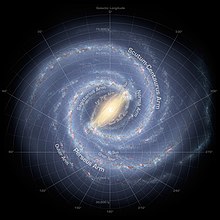
A) "The stellar disk of the Milky Way galaxy is approximately 100,000 light-years (30 kiloparsecs, 9×10¹⁷ km) in diameter, and is considered to be, on average, about 1,000 ly (0.3 kpc) thick."
"The galaxy consists of a bar-shaped core region surrounded by a disc of gas, dust and stars forming four distinct arm structures spiraling outward in a logarithmic spiral shape (see Spiral arms). The mass distribution within the galaxy closely resembles the Sbc Hubble classification, which is a spiral galaxy with relatively loosely wound arms."
"The ages of individual stars in the Milky Way can be estimated by measuring the abundance of long-lived radioactive elements such as thorium-232 and uranium-238, then comparing the results to estimates of their original abundance. These yield values of about 14.0 ± 2.4 Ga for CS 31082-001 and 13.8 ± 4 Ga for BD+17° 3248."
In 2007,  a star in the Galactic halo, HE 1523-0901, was estimated to be about 13.2 billion years old, nearly as old as the Universe.


B) According to the Big Bang theory, the Universe was once in an extremely hot and dense state which expanded rapidly. This rapid expansion caused the young Universe to cool and resulted in its present continuously expanding state.


C)
"Cosmic background radiation is well explained as radiation left over from an early stage in the development of the universe, and its discovery is considered a landmark test of the Big Bang model of the universe. When the universe was young, before the formation of stars and planets, it was smaller, much hotter, and filled with a uniform glow from its white-hot fog of hydrogen plasma. As the universe expanded, both the plasma and the radiation filling it grew cooler. When the universe cooled enough, protons and electrons could form neutral atoms. These atoms could no longer absorb the thermal radiation, and the universe became transparent instead of being an opaque fog. The photons that existed at that time have been propagating ever since, though growing fainter and less energetic, since exactly the same photons fill a larger and larger universe. This is the source for the alternate term relic radiation."

The Sun

A)
"Sunspots are temporary phenomena on the photosphere of the Sun that appear visibly as dark spots compared to surrounding regions. They are caused by intense magnetic activity, which inhibits convection by an effect comparable to the eddy current brake, forming areas of reduced surface temperature."


"A solar flare is a sudden brightening observed over the Sun surface or the solar limb, which is interpreted as a large energy release of up to 6 × 1025 joules of energy[1] (about a sixth of the total energy output of the Sun each second). The flare ejects clouds of electrons, ions, and atoms through the corona into space. These clouds typically reach Earth a day or two after the event.[2] The term is also used to refer to similar phenomena in other stars, where the term stellar flare applies."

http://en.wikipedia.org/wiki/Solar_flare ,nov 21, 2011, wikipedia ,


"The solar wind is a stream of charged particles ejected from the upper atmosphere of the Sun. It mostly consists of electrons and protons with energies usually between 1.5 and 10 keV. The stream of particles varies in temperature and speed over time. These particles can escape the Sun's gravity because of their high kinetic energy and the high temperature of the corona."
"The solar wind creates the heliosphere, a vast bubble in the interstellar medium that surrounds the Solar System. Other phenomena include geomagnetic storms that can knock out power grids on Earth, the aurorae (northern and southern lights), and the plasma tails of comets that always point away from the Sun."


B) The sun is related to the auroras by the solar flares the sun gives out.
"Satellite solar outages occur because the Sun which is a powerful broadband microwave noise source passes directly behind the satellite (when viewed from Earth) and the receiver with the beam directed towards the satellite picks up both the satellite signal and the noise from the Sun.
The degree of interference caused by a satellite solar outage varies from slight signal degradation to complete loss of signal as the downlink is swamped by the noise from the Sun."

"It's not the sun spots directly, but what's actually causing the sun spots. Which is intense magnetic activity in the sun. This causes clouds of charged particles to hit the earth, this is called a geomagnetic storm, it can affect satellites and strong ones can affects power grids by inducing currents in conductors."
 
 
C) "After the Big Bang, when the universe cooled enough for atoms to form, the only elements around were hydrogen, helium, and a little bit of lithium. The first heavier elements were formed in the cores of stars, where the temperature and pressure was high enough to drive nuclear fusion. The biggest stars formed the elements up through iron, but could not go any higher because iron fusion is endothermic. When those stars exploded as supernovae, neutron capture caused the formation of even heavier elements. That pretty much accounts for all the naturally-occurring elements."

Thursday, October 20, 2011

Climate Research Rubric. Lightning

Where On Earth: Everywhere

Why it Happens: Frozen raindrops bump into each other and the collisions create an electric charge.
Bad weather, clouds full of rain.
Impact on Environment: causes forest fires.
Impact on People and economy: Kills people and can  destroy buildings.
How do warnings issued: when you hear thunder and on the news.

Monday, October 3, 2011

Great Lakes Regional Context

1. Smallest is Erie, largest superior
2.lake erie is most urban, and most rule
3. the longest shoreline lenght is huron
the shortest is lake onterio
4.the best way to manage the eco sytem is to take in toacout the individual hauman activities and natrul resorces.
5. multiple  commpianise release organic waste. that bacteria consum this reasults in bacteria growth,use of oxygen and fish death.
acid being released into the the water causes the ph value to rise. as fish are only suited for a very narrow range of phvalues this is unheathyand causes a decress in the fish population.
6.
A) water from a house goes into the ground and is absourbed into the soil.
B) runoff is the water flow that ocures when compasity of land is met. in relation to ground capability.
C) yes. they should not because this can cause water polution.
D) Acidic rain
E) not point comes from rain and natrual disasters. point comes from one localized point such as a gas station or residental area.
F) water shed is a controller of water pollution.

Monday, September 26, 2011

what I learned on the walk

I learned bout the Red Pine and how many needles it has.


When people throw stuff into the wild it effects the PH.

Recycling Electronics

Good

My bottlhas paper in it im incarge of researching.

Wednesday, September 7, 2011

i wanna learn how to be more green and stuff.

What I know about Technology and science

Technology makes life easier and gets us to point A to point B. Technology can be good for the earth but also can be bad for earth. Technology/ science has changed and got better over the years by phones getting better then us making cell phones then cell phones getting better. Cars got better overtheyears. Thats what i know.