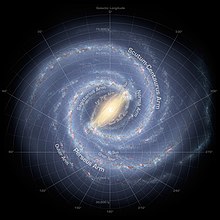
"The galaxy consists of a bar-shaped core region surrounded by a disc of gas, dust and stars forming four distinct arm structures spiraling outward in a logarithmic spiral shape (see Spiral arms). The mass distribution within the galaxy closely resembles the Sbc Hubble classification, which is a spiral galaxy with relatively loosely wound arms."
"The ages of individual stars in the Milky Way can be estimated by measuring the abundance of long-lived radioactive elements such as thorium-232 and uranium-238, then comparing the results to estimates of their original abundance. These yield values of about 14.0 ± 2.4 Ga for CS 31082-001 and 13.8 ± 4 Ga for BD+17° 3248."
In 2007, a star in the Galactic halo, HE 1523-0901, was estimated to be about 13.2 billion years old, nearly as old as the Universe.
B) According to the Big Bang theory, the Universe was once in an extremely hot and dense state which expanded rapidly. This rapid expansion caused the young Universe to cool and resulted in its present continuously expanding state.

C)
"Cosmic background radiation is well explained as radiation left over from an early stage in the development of the universe, and its discovery is considered a landmark test of the Big Bang model of the universe. When the universe was young, before the formation of stars and planets, it was smaller, much hotter, and filled with a uniform glow from its white-hot fog of hydrogen plasma. As the universe expanded, both the plasma and the radiation filling it grew cooler. When the universe cooled enough, protons and electrons could form neutral atoms. These atoms could no longer absorb the thermal radiation, and the universe became transparent instead of being an opaque fog. The photons that existed at that time have been propagating ever since, though growing fainter and less energetic, since exactly the same photons fill a larger and larger universe. This is the source for the alternate term relic radiation."

No comments:
Post a Comment